The 7 Best Optoma Laser Projector For 2026
 By, Michael Brown
Updated
Summary

Optoma GT3500HDR Laser Projector

Optoma GT2100HDR Laser Projector

Optoma GT2000HDR Laser Projector
Laser projectors have become a popular choice for users who want consistent brightness, long-term reliability, and minimal maintenance, and Optoma is one of the brands leading this space. Known for combining strong image performance with durable laser light sources, Optoma laser projectors are widely used for home theaters, gaming setups, and professional environments.
Among the available models, the Optoma GT3500HDR Laser Projector stands out as a top choice. It delivers sharp 4K visuals, impressive brightness, and a laser light source designed to last for years without frequent replacements. Choosing the best Optoma laser projector depends on how and where you plan to use it. Brightness levels, resolution, throw distance, and input lag can significantly affect the viewing experience, especially in rooms with ambient light or for gaming. In this guide, we highlight the best Optoma laser projectors, helping you compare key features and select a model that fits your space, usage, and budget with confidence.
Our Top Picks
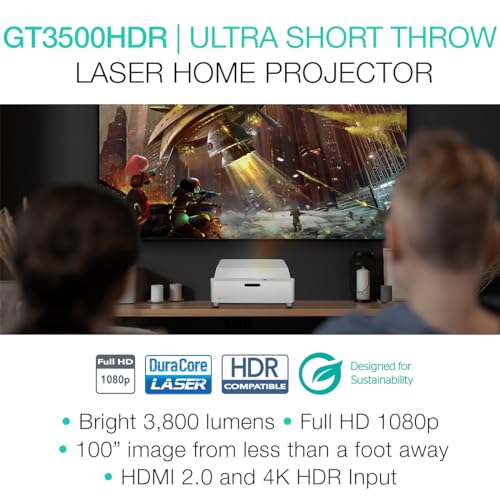

Ultra short-throw design Very low gaming input lag Bright image for many rooms Long-lasting laser light source
Fan noise is noticeable in bright mode
From the moment we looked at the specs, it was clear that the GT3500HDR focuses on convenience and speed. The ultra short throw lens means you can place it close to the wall and still enjoy a cinema-sized image, which makes setup far less stressful than with traditional projectors. Its 3800 lumens brightness and high contrast ratio help images stay clear even in rooms that are not fully dark, which is something we always appreciate for everyday use.
Gaming is where this projector really shines. Enhanced Gaming Mode drops input lag down to 8ms at 1080p 120Hz, making fast-paced titles respond quickly and smoothly. Even though it is a Full HD projector, it accepts 4K HDR signals, which adds flexibility if you plan to connect modern consoles or streaming devices. Long-term ownership also looks promising. The DuraCore laser light source is rated for up to 30,000 hours, and the airtight optical engine supports continuous operation, even around the clock. Installation feels forgiving too, with digital zoom, keystone correction, and 4-corner adjustment helping fine-tune the image.
The only thing we noticed is that fan noise can become more noticeable in bright mode, but that brightness is also what makes daytime viewing possible, so it is a trade-off many users will gladly accept.

Compact and space-saving design Long-lasting laser light source Fast response for gaming Energy-efficient operation
Short-throw placement requires precision
What stands out right away with the GT2100HDR is how much it packs into a relatively small body. Measuring just over eight inches tall, it is easy to place on a shelf or media console, yet it can project up to a 120-inch image from just over four feet away. That makes it a strong option for apartments or rooms where distance is limited. The 1080p resolution keeps images crisp without relying on scaling, which helps preserve detail in both movies and games.
Gaming performance is clearly a priority here. The enhanced game mode delivers quick response times, and support for 4K HDR input means it plays nicely with modern consoles and streaming devices. Combined with a 300,000:1 contrast ratio, colors come through with depth and clarity, giving films and games a more cinematic look.
Moreover, the DuraCore laser light source is rated for up to 30,000 hours, backed by IPX6 dust resistance for added durability. Energy efficiency is also a nice bonus, using significantly less power than traditional lamp-based projectors. Placement does take a bit of patience. The short-throw setup rewards precise positioning, but once dialed in, it delivers an impressive image that makes the extra setup effort worthwhile.

Compact short-throw design Long-lasting laser light source Fast gaming response times Energy-efficient performance
Not very bright in well-lit rooms
At first glance, the GT2000HDR fits neatly into modern living spaces. Its short-throw lens can create a 120-inch image from just over four feet away, which makes placement far easier than with standard projectors. The 1080p resolution keeps images clean and detailed without any extra processing, so movies and games appear natural and well-defined.
Gaming support is clearly part of the design. Enhanced game mode delivers fast response times, and compatibility with 4K HDR input allows it to work smoothly with newer consoles and streaming devices. Combined with a 300,000:1 contrast ratio, scenes carry good depth and balanced colors, especially in darker environments where contrast matters most.
Reliability is another area where this model makes sense. The DuraCore laser light source is rated for up to 30,000 hours and pairs with an IPX6 dust-resistant design, reducing maintenance over time. Energy efficiency also plays a role, as it uses significantly less power than traditional lamp-based projectors while staying compact enough to move or store easily.
Brightness is not its strongest trait. That said, in controlled lighting or evening viewing, the image remains enjoyable and cinematic, which aligns well with its focus on home theater and gaming in smaller rooms.
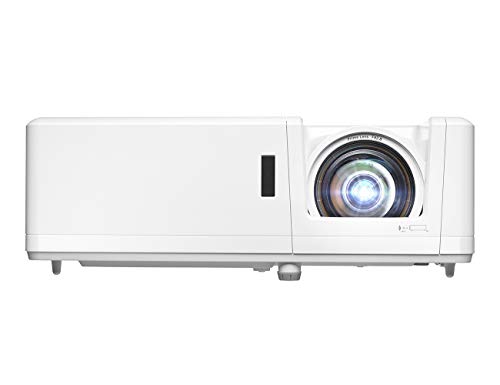
Very bright for many spaces Short throw, easy placement Long-lasting laser light source Flexible setup and connectivity
Needs calibration for best colors
Right away, the GT1090HDR shows its strengths in versatility. The short throw lens can produce a 120-inch image from just over four feet away, which makes placement easier and keeps shadows out of the way. Its 4200 lumens of brightness open up more viewing possibilities, from living rooms with lights on to outdoor setups like backyard movie nights or casual gaming during the day.
Image quality is handled by a 1080p Full HD panel with support for 4K HDR input. HDR10 and HLG compatibility help push brighter whites and deeper blacks, while the 300,000:1 contrast ratio keeps details clear without any downscaling. For gaming and streaming, connecting consoles or HDMI streaming sticks is straightforward, and support for a 120Hz refresh rate also allows smooth 3D playback when paired with compatible content and glasses.
Installation adjustments are simple thanks to auto keystone and four-corner correction, and eco-mode keeps noise levels low during movies. Out of the box, colors may not look perfectly balanced. A bit of calibration helps unlock the projector’s full potential, and once tuned, the image quality becomes far more satisfying.

Very bright for lights-on use Short throw saves space Long-lasting laser durability IPX6 dust resistance
Higher price than typical models
The ZH406STx makes a strong first impression with its ability to project a 120-inch image from just over four feet away. That short throw setup is especially useful in meeting rooms, classrooms, or tight spaces where distance is limited. Pair that with 4,200 lumens of brightness, and you get images that remain clear and readable even in well-lit environments, which is exactly what professional settings demand.
A 1080p resolution panel with a high 300,000:1 contrast ratio takes care of the image quality. Also, 4K HDR input with HDR10 and HLG makes the colours look richer without making the setup harder. Digital zoom and four-corner correction also assist in making the picture better, so installation is easier when you can't get it quite right.
Long-term operation is another area where this projector earns trust. The DuraCore laser light source is rated for up to 30,000 hours, and the IPX6 dust resistance helps protect the optical engine over years of use. Pricing sits on the higher side, but that cost reflects the brightness, durability, and low-maintenance design, which can pay off in demanding environments over time.

True 4K sharp detail Very bright for daytime viewing Excellent gaming performance support Long-lasting laser light source
HDR highlights may clip slightly
The Optoma UHZ66 is made for big rooms, big screens, and people who want true 4K clarity without turning their living space into a dedicated theater. Its long throw lens can fill a 120-inch screen from just over 12 feet away, which suits living rooms and home theaters where you have some distance to work with. Once powered on, the true 4K UHD resolution really shows its strength, delivering sharp detail with all 8.3 million pixels doing their job, especially noticeable in high-resolution films and games.
Additionally, the enhanced game mode supports extremely fast response times at 1080p240 and smooth gameplay at 4K60, which makes it a solid match for next-gen consoles and gaming PCs. Support for 4K HDR and 1080p HDR input adds richer colors and depth, backed by an impressive 500,000:1 contrast ratio. With 4,000 lumens of brightness, daytime viewing is not an issue, whether you are watching sports or jumping into a quick gaming session.
The DuraCore laser light source promises up to 30,000 hours of operation, paired with IPX6 dust resistance for long-term reliability. Connectivity is also well thought out, with dual HDMI 2.0 ports, USB power, and ARC and eARC support for easy audio setup. In very bright HDR scenes, highlights can be clipped slightly. Still, for most content, the image remains vibrant and detailed, offering a well-rounded experience for both cinema and gaming.

Ultra short-throw portability Built-in Google TV streaming Vibrant triple laser colors Strong speakers for its size
Large updates slow initial setup
Spending time with the ML1080UST feels less like setting up a projector and more like opening a smart TV that happens to project onto the wall. Built-in Google TV takes care of streaming, with certified access to Netflix and Disney+ alongside thousands of apps from the Play Store. Google Cast also makes it easy to share content straight from your phone without cables getting in the way.
Its ultra-short throw design is a real space-saver. From less than a foot away, it can fill a 100-inch screen, which works perfectly in dorm rooms, small apartments, or anywhere space is limited. The portable design and built-in battery add to that flexibility, offering up to 1.5 hours of cordless viewing and even letting you charge other devices through USB-A.
Triple Laser RGB technology powers the visuals, giving you Full HD resolution with bright, vivid colours and no need to bother about changing lamps. The built-in 20-watt stereo speakers do a fairly good job of handling sound, so you don't need any more gear to watch TV casually. Nevertheless, the initial setup can take a little patience, especially when large software updates are involved. Once completed, though, the projector settles into a smooth, cable-free experience that suits everyday entertainment beautifully.
Buying Guides For Efficiently Picking The best optoma laser projector
Experts advise that it is necessary to take a close look at the style, functionality, and value of the items you love. The most highly recommended way to know if a product is the best is by its quality checking.
The quality of the best optoma laser projector will be a vital factor, which plays a decisive role in your experience of this product. Moreover, you guys always wanna products with high-quality standards and valuable characteristics, which best suits your desired needs.
So, how can you know if your selected best optoma laser projector is of the best quality? The buying guide section below will present to you some tips for the most efficient purchase. Take a close look at the following guides!
Contrast Ratio
Contrast ratings can only be used to measure in dark rooms. They don't give any information about ambient lighting. Unusually dark blacks in the projector will result in lower contrast. A brighter projector will perform well in home theaters, but not in living rooms or offices.
Resolution
The calculation for projectors that have 4K ultra high definition (3,840 x 2,160 pixels) is slightly different.
Brightness
The ambient lighting level, size and material of your projector screen will all affect the brightness. You should buy a professional seller if you are installing a projector in a permanent location, such as at your home, to ensure that you get the best image brightness and the correct screen material.
Light Source
For longer periods of time, LEDs and lasers retain a greater percentage of their original brightness. While all light sources eventually lose their brightness, lamps lose the most in 500 hours. Then, they slowly decline over time. The brightness of LEDs and lasers will decrease more slowly over the course of their lifetimes.
Projection Tech
DLP projectors with single-chip DLP chips could be subject to the so-called "rainbow effect." Sometimes, tiny, bright flashes with rainbow-like colors may appear, especially in dark scenes. Some DLP projectors have a minimal effect, while others can produce a distracting result, especially when there are bright areas against shady backgrounds. The rainbow effect is not a problem with LCD projectors, which are safer if someone in your household has sensitive eyes. There are many DLP projectors that produce excellent images.
Connection Methods
Component video, composite video and S-Video all make up the most common connections on large projectors. We're also seeing more projectors that offer direct USB connection to computers via a USB cable. A growing variety of projectors now have USB Type-C ports. The majority of USB-C ports can be used to transfer data or video using the DisplayPort protocol. Most USB-C ports support USB Power Delivery (USB PD), which means that a plugged in projector can supply 100 watts of power to charge a device or to charge it using a USB-C cable (assuming the device is capable of charging over USB-C).
Portability
FAQs
What are the benefits of an Optoma laser projector?
Optoma laser projectors offer long-lasting brightness, consistent image quality, and low maintenance. The laser light source typically lasts much longer than traditional lamps, reducing replacement costs over time.
Are Optoma laser projectors good for home theater use?
Yes, many Optoma laser projectors are well-suited for home theaters. They provide sharp resolution, strong contrast, and stable brightness, making them ideal for movies, streaming, and immersive viewing.
Can Optoma laser projectors be used for gaming?
Absolutely. Several Optoma laser models are designed with low input lag and fast response times, making them a solid choice for console and PC gaming on large screens.
Conclusion
In short, we’ve included all the most outstanding best optoma laser projector found on the market during this time. Simultaneously, the detailed description and useful tips for best optoma laser projector selection are shown with clarity. In case you cannot afford these options, then the Optoma ML1080UST Laser Projector will be your new buddy. If you want more information about the best optoma laser projector, don’t hesitate to contact us. Our team is always here to support you guys!
About Michael Brown