The 7 Best Asus Proart Monitor Of 2025
 By, Michael Brown
Updated

Summary

ASUS ProArt 32” PA32UCDM Monitor

ASUS ProArt PA278QV 27” Monitor

ASUS ProArt PA27JCV 27” Monitor
When your work depends on color accuracy, a standard monitor simply isn’t enough. ASUS ProArt monitors are built for creators who need consistent, reliable visuals for photo editing, video production, graphic design, and other color-critical tasks. From factory calibration to wide color gamut support, the ProArt lineup is designed to deliver results you can trust.
Among the range, the ASUS ProArt 32” PA32UCDM Monitor is impressive as a clear benchmark. It offers exceptional color precision, strong brightness control, and a level of consistency that professionals expect when working on detailed projects. That said, the best ASUS ProArt monitor isn’t the same for everyone. Screen size, resolution, connectivity, and workflow requirements all matter. Some creators prioritize 4K resolution for fine detail, while others focus on color space coverage or ergonomic flexibility. In this guide, we will break down the best ASUS ProArt monitors to help you choose the right display for your creative work, budget, and long-term needs.
Our Top Picks


Exceptional color accuracy performance High brightness with deep contrast Fast refresh and response Versatile Thunderbolt 4 connectivity
Demands powerful system hardware
Sitting in front of the ASUS ProArt PA32UCDM, it becomes clear that accuracy is the main story here. The 4K UHD QD-OLED panel combines a 240 Hz refresh rate with a 0.1 ms response time, resulting in motion that stays clean and controlled even during fast transitions. Bright scenes benefit from up to 1000 nits of peak brightness, while darker content gains depth thanks to VESA DisplayHDR True Black 400 support.
Color work is where this monitor truly shines. With true 10-bit color, Quantum Dot technology, and coverage of 100 percent sRGB, 99 percent DCI-P3, and BT.2020, it is clearly tuned for professionals. ASUS ProArt Hardware Calibration and a Delta E below 1 help maintain reliable color output, and the included pre-calibration report adds confidence right out of the box.
Connectivity also supports modern workflows well. Dual Thunderbolt 4 ports with up to 96W power delivery make it easy to connect laptops, manage cables, and even daisy-chain displays. Ergonomic adjustments allow long work sessions to remain comfortable. Pushing 4K resolution at such a high refresh rate does place more responsibility on your computer hardware, but for users already running powerful systems, this requirement fits naturally into the workflow.

Accurate factory-calibrated colors Comfortable WQHD workspace Wide range of input ports Clean frameless design
No USB-C port
At first glance, the PA278QV keeps things simple, and that works in its favor. The 27-inch WQHD resolution strikes a nice balance between sharpness and screen space, giving plenty of room for timelines, layers, and side-by-side windows. Its IPS panel delivers stable viewing angles, which helps when fine-tuning visuals or reviewing work with others.
With full coverage of both sRGB and Rec. 709, along with Calman Verification and factory calibration, this monitor arrives ready for color-sensitive tasks. Delta E values under 2 mean adjustments are minimal, and ASUS adds extra control through ProArt Preset and ProArt Palette, allowing users to fine-tune color parameters based on specific projects.
Connectivity is another strength. Multiple display inputs, audio connections, and four USB 3.0 ports make it easy to integrate into mixed setups, whether you are switching between devices or connecting accessories. The frameless design keeps the workspace looking clean and modern.
The only downside is that it doesn't have a USB-C port. That said, the wide range of traditional ports still provides flexibility for many existing systems.

Ultra-sharp 5K resolution Large creative workspace Accurate, calibrated color output Built-in Auto KVM feature
No Thunderbolt connectivity
Working on the PA27JCV quickly highlights how much clarity matters in daily creative tasks. The 5K resolution delivers extremely sharp text and fine image details, making it easier to zoom, crop, and refine without constantly adjusting the view. With 77 percent more workspace than a same-sized 4K monitor, timelines, panels, and tools can stay visible while you focus on the actual work.
Color reproduction is handled with care. Factory pre-calibration to Delta E below 2, Calman Verification, and coverage of 99 percent DCI-P3 and 100 percent sRGB help ensure consistent results across different projects. The 10-bit panel can show over a billion colours, which makes subtle gradients and fine tones look more real, especially in photography and digital painting.
Another practical touch is the built-in Auto KVM. Switching between two computers using one keyboard and mouse feels smooth and reduces desk clutter, which is especially useful in multi-device setups. USB-C connectivity also supports modern workflows and future device compatibility.
Thunderbolt users may notice its absence here, meaning certain high-bandwidth or single-cable setups are not available. Still, for creators focused on resolution, workspace, and color fidelity, this trade-off remains easy to work around.
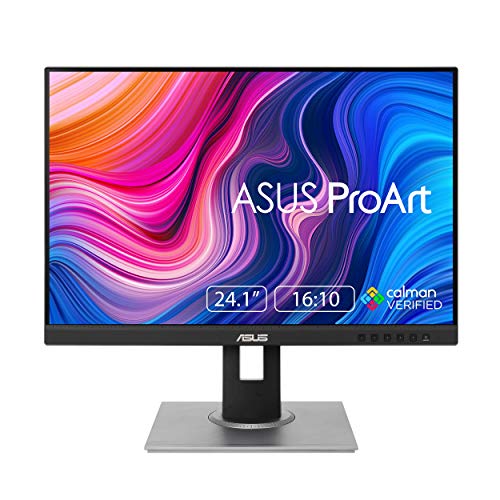
Accurate sRGB and Rec.709 Factory-calibrated color accuracy Extra vertical screen space Stable IPS viewing angles
The setup process can be tricky
The ASUS ProArt PA248QV is aimed at creators who value color accuracy in a compact, practical form. Its 1920 x 1200 WUXGA resolution provides a little extra vertical space compared to standard Full HD, which proves helpful when scrolling through images or working on layered projects. The IPS panel keeps colors stable across viewing angles, making it easier to judge visuals accurately.
This monitor shows dependable and expressive colours with 100% coverage of both sRGB and Rec.709 with Delta E values below 2. Calman Verification and factory tweaking guarantee that it comes ready for creative work, so you won't have to make any changes right away. Photos and digital art look clean, balanced, and true to the original source.
It also focuses on usability right out of the box, pairing its resolution and color accuracy into a setup that supports everyday professional workflows. Setting everything up can take a bit more patience, especially for first-time users, as the process is not entirely straightforward. Once configured, however, the display settles into a stable and reliable part of the workspace.

Increased pixel density Sharp and spacious 4K display Wide color gamut support Convenient single-cable USB-C
Built-in speakers are minimal
From the moment the PA279CRV is powered on, its 4K resolution becomes a practical advantage. The increased pixel density provides crisp detail, while the expanded onscreen space makes multitasking easier when working with timelines, scopes, and preview windows. Compared to Full HD displays, the difference in clarity and workspace is immediately noticeable.
Covering 99 percent DCI-P3, 99 percent Adobe RGB, and 100 percent sRGB, it supports a wide range of creative standards. The factory pre-calibration process, combined with Calman Verification and Delta E values below 2, helps ensure smooth gradation and reliable color output across projects. Its 10-bit panel further enhances this by displaying over a billion colors, which is especially useful when handling subtle tones in video and photo work.
USB-C connectivity adds convenience to modern workflows. One cable can handle display output, fast data transfer, and up to 96 watts of power delivery, keeping desks cleaner and setups simpler. Nevertheless, the audio is not the main focus here. The built-in speakers cover basic needs, but many users will likely pair the monitor with external speakers for a fuller sound experience.

Comfortable WQHD resolution Flexible USB-C connectivity Full coverage of sRGB and Rec.709 Works well with Macs
No support for DCI-P3 color space
On a typical workday, the PA278CV fits naturally into a professional environment. The WQHD resolution provides enough detail for precise editing while maintaining smooth performance across a wide range of systems. It also offers a generous amount of screen space, which helps when arranging documents, timelines, or design tools side by side.
The colour accuracy and consistency from one project to another is guaranteed by the full coverage of sRGB and Rec.709, together with Delta E values under 2 and Calman Verified certification. Web designers, workplace graphic designers, and content creators aiming for conventional colour spaces may find this degree of precision very helpful. This monitor comes well-calibrated, so you can focus on their job instead of making changes to the display.
USB-C support, daisy-chaining capability, an integrated USB hub, and HDMI input make it easy to connect laptops, Macs, and peripherals without clutter. These options help simplify cable management while supporting flexible workflows. Those working extensively in wider cinematic color spaces may notice that DCI-P3 coverage is not included. However, for users whose projects revolve around sRGB and Rec.709 standards, the monitor remains a dependable and well-rounded choice.

Large, spacious 32-inch screen Accurate, calibrated color output Smooth high refresh performance Desk-saving mounting bracket
IPS glow in dark scenes
This project aims to support demanding professional workflows. A 32-inch WQHD panel provides noticeably more room than standard Full HD displays, making it easier to work with multiple panels, timelines, or high-resolution images at once. Visuals appear sharp and well-defined, supported by HDR technology that expands contrast and luminance for more depth in both highlights and shadows.
With 95 percent DCI-P3 and full coverage of sRGB and Rec.709, the monitor supports a wide range of creative standards. Motion handling adds another layer of versatility. A refresh rate of up to 165 Hz, combined with FreeSync Premium Pro, allows smooth playback and makes it easier to check fast-moving content or even test interactive projects on the same display.
The included desk-mounted bracket also helps reclaim workspace, offering flexible positioning without the need for a separate stand. In darker rooms, some users may notice IPS glow around the edges. While this is more visible in low-light scenes, it generally fades into the background during regular creative work.
What To Know About The best asus proart monitor Before Purchasing It
There are numerous factors to consider buying a product. In the section below, we will give you some key points to pay attention to prior to buying a best asus proart monitor. Of course, It’s indispensable for buyers to do some research before making a purchase so that they won’t end up with something that can’t meet their expectations.
In this post, with our useful and available tips for shopping, we will make it easier for you to select and make the best decisions when tending to own the best asus proart monitor. Here is your area! Give it your attention and make it your assistant.
Brightness
Refresh Rate
Aspect Ratio
Connections
Response Time
Screen Size
Resolution
Panel Type
FAQs
What makes ASUS ProArt monitors suitable for professional work?
ASUS ProArt monitors are factory-calibrated for color accuracy and support wide color gamuts, making them ideal for photo editing, video production, and design work.
Are ASUS ProArt monitors good for photo editing and video editing?
Yes, they are designed specifically for color-critical tasks, offering accurate color reproduction, high resolution, and consistent brightness across the screen.
Do ASUS ProArt monitors support 4K resolution?
Many ASUS ProArt models offer 4K resolution, which is beneficial for detailed editing, sharp text, and precise control when working with high-resolution content.
Conclusion
Hopefully, our sharing above will take you much closer with your best asus proart monitor. The model we suggested for you is equipped with all things you may need. Nevertheless, suppose you have a fancy for another one, we highly recommend ASUS ProArt 32” Monitor PA328CGV. To conclude, we wish you a pleasant shopping time. And if there is any problem related to this article that you wonder about, please contact us soon for timely answers. It's our pleasure to serve you!
About Michael Brown