The Best 4k Projector For Home Of 2026
 By, Michael Brown
Updated
Summary

Auking 4K Projector
ViewSonic PX701 4K Projector

Hisense C2 Projector 4K
A great home theater is no longer reserved for dedicated media rooms with expensive equipment. Today's 4K projectors can turn an ordinary living room, basement, or even a bedroom into a big-screen entertainment space capable of delivering an immersive movie night without requiring a massive television. For many people, the appeal is simple: a larger image, a more cinematic experience, and better value per inch than most TVs.
Of course, not every projector marketed as "4K" delivers the same results. Brightness, contrast, color accuracy, and ease of setup all play a major role in how enjoyable the viewing experience actually is. Some models perform beautifully in dark home theaters, while others are better suited for living rooms with ambient light. Finding the right balance often matters more than chasing the highest specifications.
One projector that has attracted plenty of attention in this category is the Auking 4K Projector. It offers an accessible way to enjoy large-screen 4K entertainment at home, making it a popular choice for families, casual movie lovers, and anyone looking to upgrade from a traditional TV without spending a fortune.
Whether you're planning weekend movie marathons, streaming your favorite shows, watching live sports, or building your first home theater, the projectors below represent some of the strongest options available today for creating a true big-screen experience at home.
Our Top Picks


3000 ANSI brightness Electric keystone correction WiFi 6 connectivity Bluetooth 5.2 support
Color accuracy is average
Movie marathons, championship games, and outdoor parties all benefit from one thing above everything else: brightness. With 3,000 ANSI lumens, the AuKing keeps the picture lively enough that the experience doesn't immediately fall apart as soon as a few lights remain on. Native 1080P resolution with 4K support adds crisp detail across screens reaching up to 400 inches, making large-scale viewing genuinely enjoyable.
Moving the projector from one room to another doesn't require much patience either. Electric keystone correction lets you square the image from the remote, while the manual focus ring quickly brings everything back into sharp focus. Whether it's pointed at a living room wall or a portable outdoor screen, getting a clean picture takes very little effort.
WiFi 6 and Bluetooth 5.2 make wireless connections feel more dependable, and the projector doubles as a practical presentation tool by supporting Office files such as PowerPoint, Excel, PDF, and Word directly from connected devices. That versatility means it doesn't spend all year waiting for movie night.
Color reproduction isn't its strongest attribute, particularly during scenes where subtle gradients and highly accurate tones matter most. For everyday movies, sports, and family entertainment, the brightness tends to leave the bigger impression.

Native 4K UHD resolution 4.2ms input lag 240Hz refresh rate SuperColor technology
No built-in smart TV platform or streaming apps
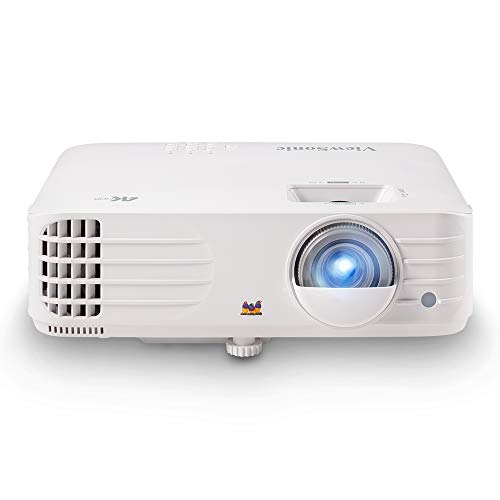
Fast-paced games expose projector weaknesses almost instantly, which is exactly where the PX701-4K separates itself. Its 4.2ms input lag and 240Hz refresh rate keep movement fluid and responsive, making racing titles, shooters, and sports games much more satisfying on a massive screen than many projectors can manage.
The visual experience holds up well outside gaming too. Native 4K UHD resolution combines with SuperColor technology and HDR/HLG compatibility to create richer colors, stronger contrast, and more depth across movies and streaming content. Images remain engaging whether you're watching from an 80-inch setup or stretching closer to the projector's 150-inch capability.
Installation is refreshingly forgiving thanks to optical zoom, digital zoom, horizontal and vertical keystone correction, four-corner adjustment, and auto keystone. Once everything is in place, connecting consoles, PCs, media players, or laptops is straightforward through the available HDMI and USB connections.
You'll want to pair it with an external streaming device if services like Netflix or Disney+ are part of your routine, since smart TV apps aren't built into the projector itself. Fortunately, adding a streaming stick is a simple one-time solution.

Pure Triple Color Laser 1.67x optical zoom AI 4K Upscaler 360° angle adjustment
Cooling fan may be audible during demanding HDR playback
Rearranging furniture just to line up a projector quickly gets old. The C2 Ultra avoids that problem with a highly adjustable design featuring 360-degree horizontal rotation, generous vertical tilt, and 1.67x optical zoom. Finding the right angle becomes part of the experience instead of a frustrating setup process.
Its flexibility wouldn't matter much without a strong picture, and that's where the triple laser light source earns its place. Richer colors, cleaner whites, and deeper detail give movies, broadcast TV, and streaming content a noticeably more refined appearance. Hisense's AI 4K Upscaler works quietly in the background as well, bringing older content closer to native 4K quality without sacrificing sharpness.
Large projection sizes are another highlight. The projector supports images from 65 to 300 inches while maintaining full 4K resolution during optical zoom, making it easy to move between smaller indoor spaces and expansive backyard movie nights without compromising image quality.
During demanding HDR playback, the cooling fan becomes easier to notice than it does with lighter viewing sessions. Fortunately, once a movie gets going, it tends to fade into the background.

Dual 60W Dolby Audio AI Sound Master Smart TV Pro OS 2.0 Built-in streaming apps
Image quality may soften at the largest screen sizes
The first impression comes before the projector even powers on. Its matte white finish, fingerprint-resistant coating, and clean styling make it look more like a premium piece of home décor than another black electronics box sitting on a shelf.
Once the movie starts, the audio becomes the star of the experience. Dual 60W Dolby Audio speakers tuned by Hollywood experts produce a room-filling soundstage with noticeably stronger bass and clearer dialogue than typical built-in projector speakers. AI Sound Master technology further enhances the presentation by reducing echo and balancing highs, mids, and lows automatically.
Its Smart TV Pro OS 2.0 keeps entertainment equally simple. Built-in access to YouTube, Prime Video, Disney+, and thousands of live TV channels means there's no immediate need to connect an external streaming stick before settling in for the evening. Faster startup times help everything feel closer to using a modern smart TV than a traditional projector.
Stretching the image to its absolute maximum size introduces a slight loss of crispness compared to more moderate screen sizes. Staying below that upper limit rewards you with a noticeably cleaner picture.

4K laser projection Bright HDR performance Low input lag Long-life laser light source
Premium pricing for a single-chip DLP projector
The appeal of laser projection becomes obvious over time. Instead of worrying about lamp replacements or gradual brightness loss, the TK710 is designed to maintain stable color and image quality throughout years of regular use. That consistency makes it just as enjoyable for weekly movie marathons as it is for everyday viewing.
HDR content benefits from the projector's bright image handling, bringing extra depth to movies, sports broadcasts, and modern games without demanding a perfectly dark room. The balanced picture tuning pairs nicely with low input lag, creating a setup that transitions naturally between cinema nights and console gaming.
Another welcome advantage is the simplified ownership experience. Moving from a traditional lamp projector to a laser light source means less routine maintenance while preserving dependable image performance over the long run. It's the kind of upgrade that continues paying off long after installation day.
Its price lands above many competing single-chip DLP projectors, making it a larger investment upfront. Buyers looking for long-term reliability may find that easier to justify than those shopping purely on cost.

4K PRO-UHD technology Precision Shift Glass Plate Epson Picture Processor 3-chip 3LCD engine
Large chassis requires ample installation space
A great home theater doesn't rely on brightness alone. Epson's 3-chip 3LCD engine continuously displays the full RGB signal for every frame, producing rich color without the rainbow artifacts often associated with other projection technologies. The result is a picture that remains natural, balanced, and consistently bright throughout an entire movie.
Sharpness receives just as much attention. The combination of 4K PRO-UHD processing and Precision Shift Glass Plate Technology creates an exceptionally detailed 3840 × 2160 image, while the Epson Picture Processor continuously refines color, contrast, HDR performance, frame interpolation, and resolution enhancement behind the scenes. Fine textures, facial details, and cinematic landscapes all benefit from the extra processing power.
The laser light source ties everything together by delivering dependable brightness alongside impressive black levels and color accuracy. Rated at 2,500 lumens for both color and white brightness, the LS11000 remains comfortable to watch even in rooms with a modest amount of ambient light.
Its generous dimensions ask for a little planning before installation, particularly if shelf or ceiling space is limited. Once it's in place, though, it's clearly intended to stay there for years.

MALC 2.0 triple laser 4K UHD with HDR10 Integrated gimbal design Real-time autofocus
Built-in speakers are good but still benefit from external audio for larger rooms
Finding the right viewing angle rarely takes more than a few seconds. The integrated gimbal rotates up to 127 degrees vertically, making it easy to project onto a wall, a ceiling, or an outdoor screen with one hand. Real-time autofocus and automatic keystone correction immediately fine-tune the image, so you're spending more time watching than adjusting settings.
Visual performance comes from JMGO's MALC 2.0 pure RGB triple laser system, which delivers 4K UHD resolution, HDR10 support, and an exceptionally wide color range covering 110% BT.2020 and 151% DCI-P3. Removing the traditional color wheel eliminates rainbow artifacts, while speckle reduction helps preserve image clarity across every frame.
Entertainment extends beyond the picture as well. Dual 10W Dolby Audio speakers create immersive surround sound, Blu-ray 3D support adds another layer of realism, and projections up to 200 inches bring genuine theater scale into almost any room.
The built-in speakers perform well for everyday viewing, although larger living rooms benefit from adding a dedicated sound system to fully match the scale of the projected image.
What to Look For in a best 4k projector for home?
Sometimes, purchasing a product can draw some difficulties for shoppers, and that's why you shouldn't waste your time on unreliable sources of information. A variety of variables impact the best 4k projector for home, along with all of the ones listed below. The formative assessment varies depending on the types and functions of the product.
We will give you some purchase guides to help you with your selection proc in the following sectors. Continue reading to learn about what you should look for when looking for the best 4k projector for home:
Resolution
The calculation for projectors that have 4K ultra high definition (3,840 x 2,160 pixels) is slightly different.
Connection Methods
Component video, composite video and S-Video all make up the most common connections on large projectors. We're also seeing more projectors that offer direct USB connection to computers via a USB cable. A growing variety of projectors now have USB Type-C ports. The majority of USB-C ports can be used to transfer data or video using the DisplayPort protocol. Most USB-C ports support USB Power Delivery (USB PD), which means that a plugged in projector can supply 100 watts of power to charge a device or to charge it using a USB-C cable (assuming the device is capable of charging over USB-C).
Light Source
For longer periods of time, LEDs and lasers retain a greater percentage of their original brightness. While all light sources eventually lose their brightness, lamps lose the most in 500 hours. Then, they slowly decline over time. The brightness of LEDs and lasers will decrease more slowly over the course of their lifetimes.
Portability
Brightness
The ambient lighting level, size and material of your projector screen will all affect the brightness. You should buy a professional seller if you are installing a projector in a permanent location, such as at your home, to ensure that you get the best image brightness and the correct screen material.
Contrast Ratio
Contrast ratings can only be used to measure in dark rooms. They don't give any information about ambient lighting. Unusually dark blacks in the projector will result in lower contrast. A brighter projector will perform well in home theaters, but not in living rooms or offices.
Projection Tech
DLP projectors with single-chip DLP chips could be subject to the so-called "rainbow effect." Sometimes, tiny, bright flashes with rainbow-like colors may appear, especially in dark scenes. Some DLP projectors have a minimal effect, while others can produce a distracting result, especially when there are bright areas against shady backgrounds. The rainbow effect is not a problem with LCD projectors, which are safer if someone in your household has sensitive eyes. There are many DLP projectors that produce excellent images.
FAQs
Is a 4K projector worth it for home use?
Yes. A 4K projector delivers sharper images, greater detail, and a more immersive viewing experience, making it ideal for movies, sports, and gaming.
How many lumens do I need for a home projector?
For most home setups, 2,000–3,000 lumens is sufficient. Brighter rooms may benefit from projectors with 3,000 lumens or more.
Do all 4K projectors support streaming apps?
No. Some models include built-in smart platforms, while others require a streaming device such as a Fire TV Stick, Roku, or Apple TV.
Generally, new information is continuously included into of best 4k projector for home. Visit our sites for revisions and improvements regularly.
You now have a far better knowledge of how to purchase the best 4k projector for home on the market. Hopefully, we've supplied you with enough information to help you make an informed decision. We'll see you in the following article.
About Michael Brown